












































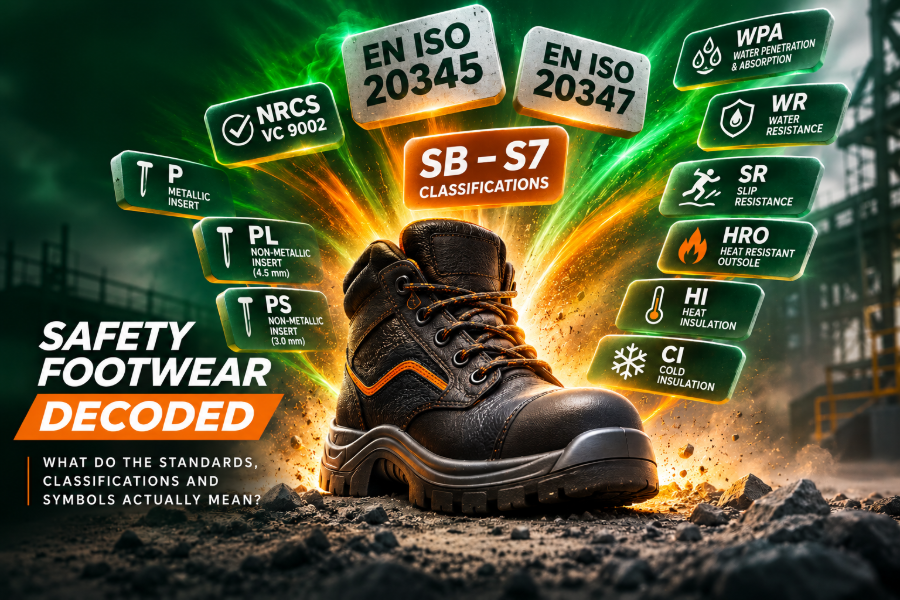
Choosing the right safety footwear is about more than finding a comfortable pair of boots. Behind every safety shoe or boot is a set of standards, classifications and markings that indicate the type of protection it has been tested to provide.
But what do all those letters and numbers on the tongue label actually mean?
At Pienaar Brothers, we believe that knowing your PPE is just as important as wearing it. Here's our guide to understanding the standards behind your safety footwear.
___________________________________________________________
1. Understanding the standards
Before looking at the different classifications, it is important to understand the standards that distinguish safety footwear from occupational footwear.
EN ISO 20345 – Safety Footwear
EN ISO 20345 specifies the requirements for safety footwear fitted with protective toe caps designed to withstand an impact of 200 joules, along with other applicable safety requirements. If footwear is classified under this standard, it has been tested against the requirements for safety footwear.
EN ISO 20347 – Occupational Footwear
EN ISO 20347 covers occupational footwear that does not require a protective toe cap.
These shoes still need to meet specific performance and safety requirements, depending on their classification. They are commonly used in environments such as healthcare, hospitality, cleaning and certain service industries, where workplace hazards may not require protective toe caps.
The key difference: EN ISO 20345 requires a protective toe cap, whereas EN ISO 20347 does not.
___________________________________________________________
2. What is an NRCS number?
When purchasing safety footwear in South Africa, you may notice a unique number printed on the tongue label of the shoe or boot.
This is the NRCS approval number.
The National Regulator for Compulsory Specifications (NRCS) is responsible for administering compulsory specifications to ensure that regulated products meet the applicable safety and compliance requirements. Safety footwear is regulated under Compulsory Specification VC 9002. Each approved type of safety footwear receives a unique NRCS approval number.
An example of the number format is: NRCS/9002/222222/1111
Here's what each section means:
Number | What it represents |
NRCS | National Regulator for Compulsory Specifications |
9002 | The compulsory specification for safety footwear |
222222 | The NRCS customer number |
1111 | The sequential approval number identifying the specific approved footwear type |
The NRCS approval number should appear prominently on the tongue label of approved safety footwear.
Why does it matter?
The number identifies footwear that has received the required regulatory approval. It is an important indication of compliance when purchasing safety footwear in South Africa. If the number does not appear, then the footwear has not been authorised for sale in South Africa as a safety shoe or boot.
Remember, the NRCS number is not a safety classification. It does not tell you whether the footwear is S1, S2 or S3. You still need to check the product's classification and additional markings to determine whether it is suitable for your working environment.
___________________________________________________________
3. Understanding safety footwear classifications
The safety classification tells you which basic and additional protection requirements the footwear meets.
Under the EN ISO 20345:2022 edition, the main classifications range from SB to S7.
The classifications are cumulative in many cases, meaning that higher classifications include additional requirements beyond the lower classifications.
Class I and Class II footwear
The classifications are also influenced by the construction of the footwear:
- Class I: Footwear made from leather and other materials, such as textile uppers.
- Class II: Fully moulded footwear made from rubber or polymeric materials, such as PVC or PU gumboots.
Safety footwear classification guide
Classification | What it means |
SB | Basic safety requirements, including a 200J protective toe cap. |
S1 | SB requirements, plus a closed heel, antistatic properties and energy absorption in the heel. |
S2 | S1 requirements, plus resistance to water penetration and absorption in the upper material (WPA). |
S3 | S2 requirements, plus penetration resistance and a cleated outsole. |
S4 | Fully moulded rubber or polymeric safety footwear with a protective toe cap, antistatic properties, heel energy absorption and a cleated outsole. |
S5 | S4 requirements, plus penetration resistance. |
S6 | S2 requirements, plus water resistance of the complete footwear (WR). |
S7 | S3 requirements, plus water resistance of the complete footwear (WR). |
A note about the newer classifications: Under the 2022 edition, S3, S5 and S7 can have additional L or S suffixes (S3L, S3S, S5L, S5S, S7L and S7S). These identify the type of non-metallic penetration-resistant insert used and the test method applied.
The classification alone does not tell you everything about the footwear. Additional markings can indicate further protection against specific workplace hazards.
____________________________________________________________
4. Penetration resistance: P, PL and PS
Sharp objects such as nails, screws, metal fragments and other debris can present a serious risk to workers' feet.
Penetration-resistant inserts are incorporated into the sole of safety footwear to help prevent sharp objects from penetrating through to the foot.
There are three main markings to understand:
Marking | Meaning |
P | Penetration resistance provided by a metallic protective insert, tested using a 4.5 mm test nail. |
PL | Penetration resistance provided by a non-metallic insert, tested using a 4.5 mm test nail. |
PS | Penetration resistance provided by a non-metallic insert, tested using a 3 mm test nail. |
Non-metallic inserts are often lighter and more flexible than traditional metal inserts. However, the different test methods mean that P, PL and PS should not automatically be considered interchangeable.
____________________________________________________________
5. Slip resistance: SR
Slippery floors are a common workplace hazard, particularly in environments where water, oils or other substances may be present.
Under EN ISO 20345:2022, basic slip resistance is a mandatory requirement for safety footwear.
However, footwear that passes an additional slip-resistance test can carry the SR marking.
SR = Slip Resistance
This marking indicates that the footwear has passed an additional slip-resistance test on a ceramic tile surface using glycerol.
It is important to remember that SR does not mean slip-proof. Actual grip will depend on the flooring, contaminants, footwear condition and working environment.
____________________________________________________________
6. Water resistance: WPA and WR
Not all water-resistant footwear offers the same level of protection. This is where WPA and WR come in.
Marking | Meaning |
WPA | Tests the upper material for water penetration and absorption. |
WR | Tests the complete footwear for water resistance. |
The distinction is important.
WPA relates to the upper material, while WR indicates that the complete shoe or boot has undergone water-resistance testing.
For workers operating in wet environments, understanding the difference can help when selecting suitable footwear.
_____________________________________________________________
7. Temperature resistance: HI, CI and HRO
Some workplaces expose footwear to extreme temperatures, whether from hot industrial surfaces or cold working conditions.
Three markings are particularly useful:
Marking | Meaning | What it indicates |
HI | Heat Insulation | The footwear's sole construction has been tested to provide insulation against heat from the ground. |
CI | Cold Insulation | The footwear's sole construction has been tested to provide insulation against cold from the ground. |
HRO | Heat Resistant Outsole | The outsole has been tested to withstand contact heat of up to 300°C for 60 seconds. |
HI and CI relate to thermal insulation, whereas HRO relates specifically to the outsole's resistance to direct contact heat.
These markings are particularly relevant in industries such as foundries, metal fabrication, manufacturing and cold storage.
_____________________________________________________________
8. Protection against cuts, impact and abrasion: M, AN, CR and SC
Certain working environments expose footwear to additional physical hazards. The following markings identify specific protective features:
Marking | Meaning | What it indicates |
M | Metatarsal Protection | Additional protection for the upper midfoot against impact and compression. |
AN | Ankle Protection | Additional protection designed to help protect the ankle against external impact. |
CR | Cut Resistance | Additional resistance to cuts through the footwear's upper material. |
SC | Scuff Cap | Additional abrasion resistance around the toe area to reduce wear caused by repeated scuffing. |
These features are particularly useful in environments involving heavy materials, sharp objects, rough surfaces and frequent kneeling.
It is important to distinguish between protection against impact and protection against abrasion. For example, SC helps protect the footwear from wear and tear, while the protective toe cap provides impact and compression protection.
__________________________________________________________
9. Managing electrical charge: A and C
Electrical properties are another important consideration when selecting safety footwear.
Static electricity can build up on the body during normal workplace activities. In certain environments, this can create risks for sensitive electronic equipment or processes involving flammable substances.
Two important markings are:
Marking | Meaning | What it indicates |
A | Antistatic | Allows static electricity to dissipate in a controlled manner, helping reduce charge build-up. |
C | Conductive | Footwear with very low electrical resistance, allowing electrical charges to dissipate more rapidly. |
Although both help manage static electricity, they are designed for different applications.
Antistatic footwear provides controlled electrical resistance, while conductive footwear allows electrical charges to pass through more easily.
Important: Neither antistatic nor conductive footwear is designed to protect against electric shock. Conductive footwear should only be selected where specifically required by the workplace risk assessment.
______________________________________________________
10. Additional safety footwear markings: E, FO and LG
There are a few other markings worth knowing when selecting footwear for specific working conditions.
Marking | Meaning | What it indicates |
E | Energy Absorption | Energy absorption in the heel region. |
FO | Fuel Oil Resistance | The outsole has been tested for resistance to fuel oil. |
LG | Ladder Grip | The outsole incorporates a design feature intended to improve grip when working on ladder rungs. |
These features can be particularly useful in environments where workers spend long periods walking or standing, work around fuels and oils, or regularly use ladders.
FO does not mean the footwear is resistant to every chemical, oil or fuel, and LG does not replace appropriate ladder safety procedures.
____________________________________________________
11. How do you choose the right safety footwear?
Understanding the markings is only the first step. The most important consideration is selecting footwear that matches the hazards present in your working environment.
For example:
Working environment | Features to consider |
Construction and general industrial work | Appropriate safety classification, toe protection and penetration resistance where sharp objects are present. |
Warehousing and logistics | Suitable toe protection, slip resistance and comfort for prolonged standing and walking. |
Wet working environments | WPA or WR, depending on the level of water exposure. |
Welding and metal fabrication | Suitable toe protection, heat-resistant outsole and additional protection where sparks, hot materials or sharp objects are hazards. |
Cold storage | Cold insulation (CI). |
Foundries and hot industrial environments | Heat insulation (HI) and/or heat-resistant outsole (HRO), depending on the exposure. |
Environments requiring static control | Antistatic (A) or conductive (C), as specified by the workplace risk assessment. |
Work involving ladders | Ladder grip (LG). |
There is no single safety boot that is suitable for every workplace. The correct selection depends on the risks involved, the applicable standards and the specific features of the footwear.
Always consult your safety officer, SHEQ manager or PPE specialist when selecting footwear for a particular application.


Comments